Collision Assistance
While most fleet systems focus on preventing collisions through driver monitoring and route optimization, collisions remain inevitable in this line of work creating stressful, high-stakes situations that disrupt operations and communication.
Role
User Researcher, Project Management
Timeline
Fall 2025
Tools
Verizon Connect Reveal, User Interviews, FigJam, Zoom
Skills
User Interviews, Survey Design, Competitor Analysis, Affinity Mapping, Persona Creation, Prototyping, Think-Aloud Protocol, Heuristic Evaluation, Prototype Evaluation

Context
Verizon Connect Reveal is a GPS-based fleet management platform that helps managers streamline daily operations. Despite its robust capabilities, Reveal lacks dedicated support for post-collision management.
Note: For our purposes, we have defined a collision as an event that 1. Caused damage to the vehicle, 2. Caused no injuries, and 3. May or may not involve a second party.
This brings us to our problem statement.
How might we understand post-accident needs and design a solution that improves or streamlines the fleet manager or driver’s experience?
Guiding Questions
Before we got started on solving the problem, we developed the following questions to guide our research.
What are the post-collision needs?
What does the current post-collision process entail?
Who do we have the most potential to support through our design efforts: drivers or managers?
Initial Research Activities
Competitive Analysis
We wanted to understand how the industry supports post-collision workflows as well as identify gaps, unmet needs, and opportunities that our design could address.
We had selected 7 competitors: Nauto, Samsara, Omnitracs, PowerFleet, Onstar, Wex telematics, iFleet and Orion Technology
Selected feautures: Automatic collision detection, Immediate Alert, Incident/collision report, Messaging Integration etc.

Website Walkthrough
The main goal of conducting a website walkthrough was to understand the current experience on the Reveal platform. We wanted to see what the experience actually feels like, where it works well, and where there are gaps or opportunities. This also helped us get a better sense of the platform’s interaction style.
One limitation of this approach is that we were still viewing the platform through our own perspectives. Since we’re not the actual drivers or managers, it may have skewed our understanding.

On-Site Visit
One of my favourite memories of this project included a visit to the Verizon office in Alpharetta. The team there had walked us through both the software and the hardware currently in use. That gave us helpful context around how the platform is used in real-world settings.


Surveys
We the conducted a survey to gather quick, quantitative insights about how drivers and managers handle collisions.
We received 55 responses, with 29 meeting our inclusion criteria: 20 managers and 9 drivers.
One of the findings that we have here : after a collision, the most relied-upon tool is personal cell phones with insurance portals and fleet management software coming second.
This tells us that even with enterprise systems available, the workflow is still dependent on direct, ad-hoc communication.

Semi Structured Interviews
The goal of these interviews was to understand the post-collision process from both the drivers’ and managers’ perspectives. On the manager side, we wanted to learn what information they need after a collision, how they’re notified, and the steps they take to resolve the situation. From the drivers, we focused on understanding their thought process and actions immediately following a collision.
We recruited participants through UserInterviews.com using a screener survey. As a team, we conducted a total of 11 interviews, each lasting about 45 minutes. This included 7 managers and 4 drivers. Of these, I lead 2 manager interviews and 1 driver interview and took notes for the others.
Analysis and Research Findings
Affinity Mapping
We created an affinity map to organize and and analyze our findings

Translating Research into Design Implications
Based on our research findings, we identified seven key design implications that directly informed the features and workflow of the final solution.
Research Finding | Design Implication |
|---|---|
The post-collision process is manual, time consuming, and scattered. | The design should support the manager in reducing the manual and time consuming aspects of post-collision management. |
There is a lack of standardization across companies. | The design should supply a clear checklist for the tasks in the post-collision process that will allow companies to align on a consistent protocol. |
The post-collision process is a group effort. | The design should help fleet managers easily gather information and details from drivers and external partners, such as insurance or repair shop contacts. |
After collisions, drivers, as well as both the finances and reputation of the company, need to be protected from false liability claims. | The design should continue to support the existing dash-camera video feature. |
Collisions can affect operations over an extended period of time. | The design should help the company record the history of communications and documentation from all stakeholders, such as the insurance companies and other related parties. |
Post-collision communication between drivers and managers relies on ad-hoc methods rather than a defined system. | The design should include features that allow the drivers to contact their managers after a collision more effectively. |
Getting a vehicle back on the road as quickly as possible is high priority. | The design should include features that streamline the coordination between managers and repair companies to expedite the process of getting the vehicle back on the road. |
While all seven design implications informed our solution, we prioritized the first three because we believed they would have the greatest impact on improving the post-collision workflow.
Design Details
Ideation and Sketched Concepts
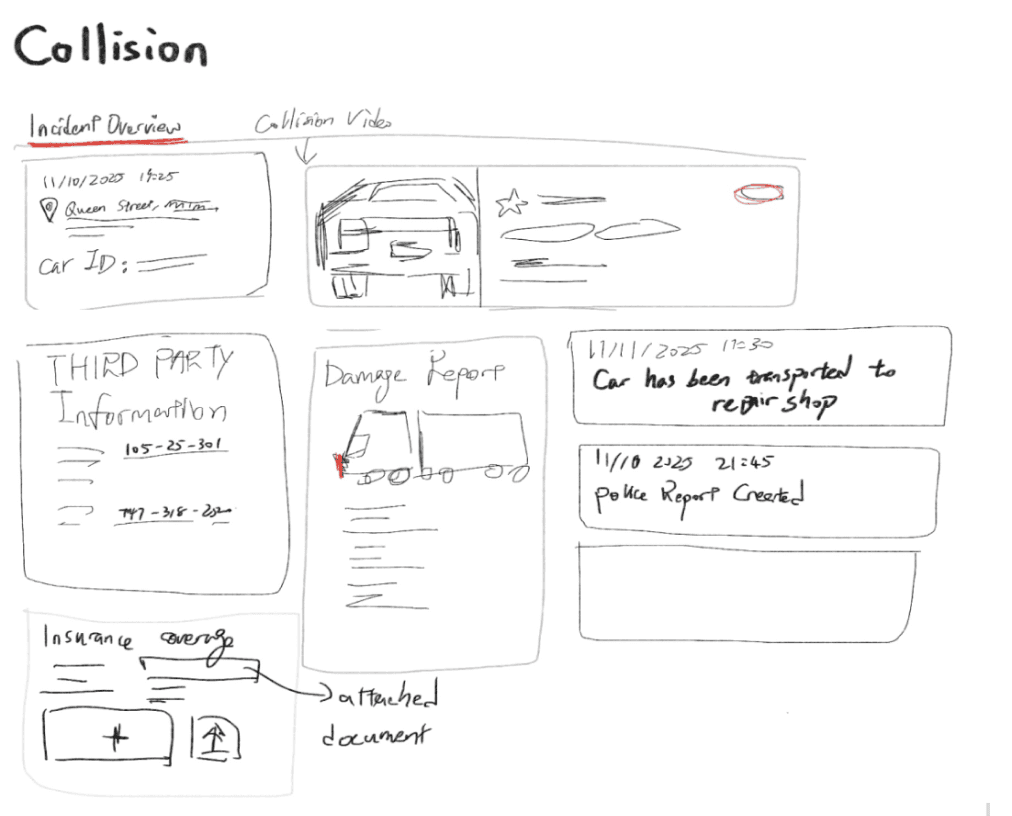
During our group brainstorming session we came up with 10 features that meet our design requirements. Next, we turned those ideas into sketches.



Concept Critique
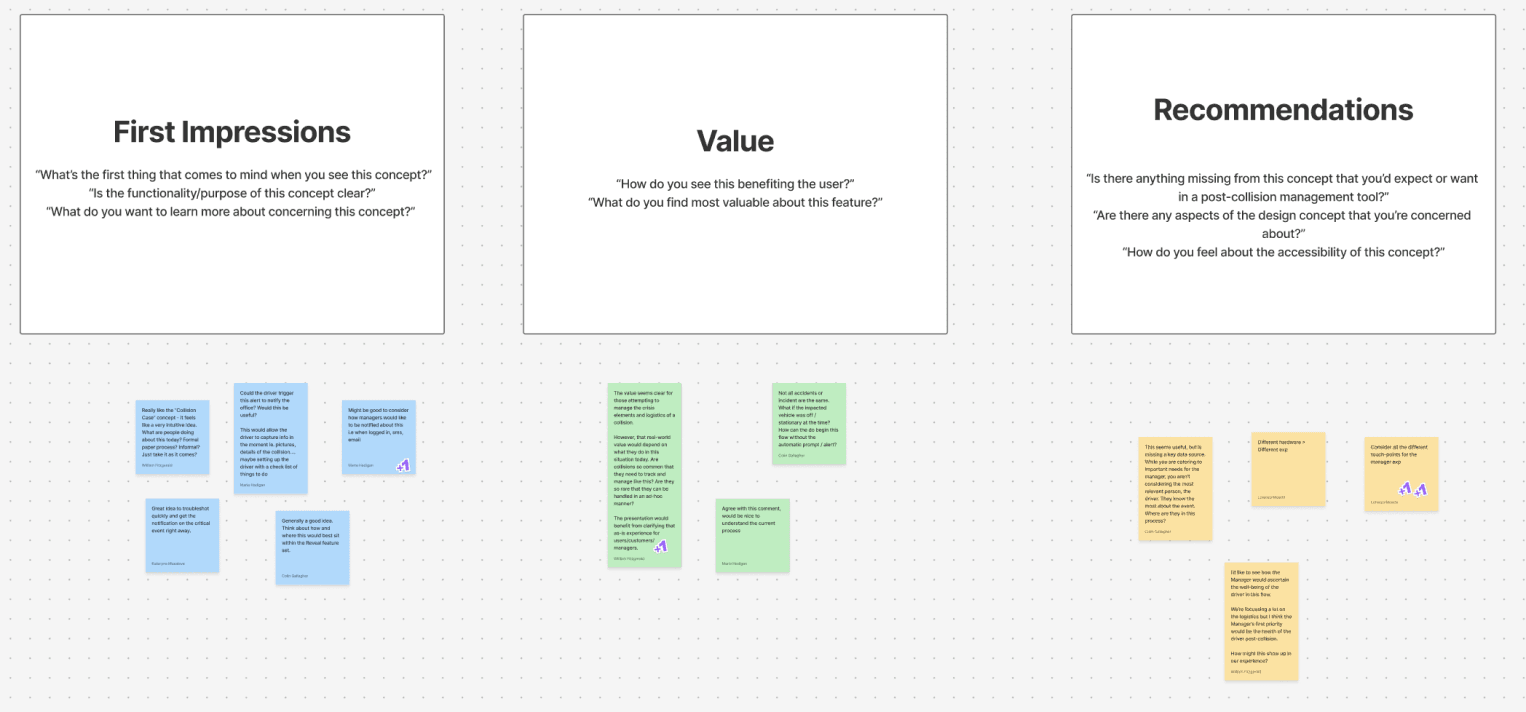
Once we had our concept, we conducted a design critique with expert designers and researchers at Verizon. We had a 45 minute session where we introduced our project, explained the stage that we were in and which feedback we are looking to receive. Then, we gave them a walkthrough of our requirements and the user flow, along with a more detailed explanation of each concept. After each explanation, we took some time for them to write on sticky notes, or in some cases tell us aloud, what they like, what they thought should change, first impressions, and any other thoughts they had.
As a team, we then took all of those sticky notes and grouped them by themes that we saw arise.


Wireframes
With the feedback from the critique, we developed our wireframes.
Feedback | How might we address this |
|---|---|
Include the driver in the process | Allow the driver to upload additional data from the collision site |
Need for more than photos and videos | Replace it to media page and add options for other types of media |
The idea of the checklist is good to lower cognitive load and to speed up things. Consider that every company probably have their own way to resolve collision, so consider how we can make it customizable. (Customizability) | Add the option for custom tasks to the checklist |
The insurance portal API is unrealistic/not very feasible | Defer the insurance portal to later stage |
Ability to download data | Add a download option to the media page |


Wireframes Analysis
With those wireframes, we conducted two 30 minute feedback sessions with real fleet managers. For these sessions, we wanted to know what they thought about the features and how they would or would not actually benefit them in the real case of a collision. We did these sessions as think alouds and we asked them questions about their initial thoughts, clarity, if it does what they expected it to, and how it can be more accessible.
The fleet managers gave us great feedback as well, and we found themes in their responses by open coding the transcripts.
Feedback | How might we address this |
|---|---|
Helpful to know who's at fault | Videos should support manager to determine who’s at fault. |
Incorporating driver facing camera to see driver reaction would be helpful. | Integrate driver-facing camera footage into the collision detail view, alongside road-facing footage for fuller context. |
Being notified through text is my preferred way, I like to have all options though, I want to have email, and all the backup channels. | Ensure multi-channel alerts are supported. |
I would use checklist to know where I am in the process. | Include a progress checklist or status tracker (e.g., Report filed → Under review → Repair scheduled |
Other people within my org might not have the most up to date information. | Collision Case detail should support information sharing. |
Heuristic Evaluation
For our first evaluation method, we conducted a remote, unmoderated heuristic evaluation using Jakob Nielsen’s 10 usability heuristics, and this was completed by six design experts from Verizon Connect. Most heuristics averaged between 1 and 2, which indicates minor usability issues.
However experts still highlighted several areas that could be improved to better support fleet managers’ needs.


Cognitive Walkthrough
Our next evaluation was a cognitive walkthrough with fleet mangers. We conducted a moderated, remote cognitive walkthrough with five fleet managers.
Using a screener, we specifically recruited fleet managers who had experience with Verizon Connect Reveal or a similar fleet management system.
For our walkthrough we wanted to identify 3 things:
If there were any usability issues
Where users encounter confusion when completing tasks.
Evaluate whether the prototype aligns with real-world scenarios


High-Fidelity Prototype
With all of our research and findings we created a high-fidelity prototype which we presented to 20+ Verizon Connect employees across the globe.
Link To Figma Design: https://www.figma.com/design/rIBUYUipaCSrT26gduk4Tf/R4-Concepts?node-id=244-1468&t=3qaYtVDipt1AyZC9-1
Learnings
It is difficult to condense everything I learned over the course of this semester-long project into a single section. Working alongside an incredibly talented team, experienced mentors, and an industry sponsor challenged me to grow not only as a UX researcher, but also as a designer, communicator, and collaborator. Looking back, these are the lessons that have stayed with me the most.
Research is iterative, not linear
One of the biggest lessons I learned was that research rarely goes exactly as planned. Our first round of semi-structured interviews revealed which questions generated meaningful insights and which needed refinement. Revisiting our findings after each round of research allowed us to uncover new patterns, challenge earlier assumptions, and continuously improve our understanding of the problem space.
Good facilitation matters as much as good questions
Conducting interviews taught me that every participant communicates differently. Some participants needed reassurance and prompts before sharing their experiences, while others immediately provided detailed feedback. Small adjustments, such as providing context before jumping into wireframes, made a significant difference in the quality of the feedback we received.
Prioritization is a design skill
Throughout the project we identified far more opportunities than we could realistically address. Rather than trying to solve every problem, we learned to prioritize the ideas that would create the greatest impact for users and align with business goals.
Design is collaborative
Every workshop, critique, interview, and design review strengthened our solution and reinforced that great UX is never created in isolation. The final prototype reflects the collective effort of researchers, designers, stakeholders, and our industry partner working toward a shared goal.
Acknowledgements
This project would not have been possible without the guidance and support of many people.
I am incredibly grateful to my teammates for their dedication, and willingness to always help one another throughout the semester. Working with this team was one of my favourite parts of the project. They are also the very first friends I made during this Master's program.
A special thank you to our faculty mentors for their thoughtful feedback and continuous encouragement, which helped us grow as researchers and designers.
Finally, I would like to thank our industry sponsor, Verizon Connect, and everyone who shared their time through interviews, workshops, usability studies, and design critiques. Their expertise and feedback directly shaped our understanding of the problem and ultimately led to a stronger solution.